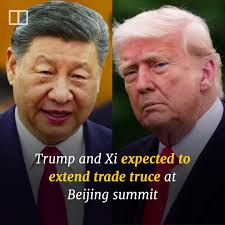
U.S. President Donald Trump and Chinese President Xi Jinping are anticipating an early April meeting in Beijing to negotiate a longer extension of the current trade truce between the two countries. Additionally, the two presidents plan to discuss ways to further extend the truce (actually originally established in Busan, South Korea) through mid-April 2007 during discussions taking place in conjunction with the annual G20 summit held in Toronto, Canada.
The Busan agreement included an end to the practice of escalating tariffs that were mutually applied for approximately six weeks prior to the start of the new agreement. The last major trade dispute prior to the establishment of the Busan agreement occurred when China stopped purchasing large quantities of U.S. agricultural commodities due to the imposition of punitive tariffs on a number of commonly traded products (such as soybeans and apples). In conjunction with the establishment of the Busan agreement, Chinese authorities have resumed making significant purchases of U.S. agricultural commodities (especially soybeans).
In addition, reports today from China indicate that the Chinese will be coordinating with their domestic businesses who export agricultural products to the United States in preparation for longer term agreements for purchasing their agricultural products. By entering into these new long term agreements, China is providing reassurance that its commitments are based on goodwill instead of making difficult concessions on sensitive issues, such as the advanced technologies or security-related matters.
The need for political objectives to be realized has increased for Washington. Before his upcoming US elections, President Trump is under pressure. If Chinese imports of US agricultural goods increase, it will provide a visible boost to US farmers and voters. After a telephone call recently with Xi, Trump indicated that an expansion of Chinese soy purchases was likely, which reinforces expectations that an agreement will be reached.
According to the South China Morning Post , Trump is expected to arrive in Beijing on March 31 and have a three-day stay in China before an early April summit. If the trade truce continues, there may be less uncertainty in the marketplace over the near term; however, analysts caution that none of the issues underlying the tensions between the US and China have been resolved.