Beijing —
For China, the record $1.2 trillion annual trade surplus its authorities reported Wednesday is resounding proof of the resilience of its economy in the face of US trade friction.
But the historic figure also tells another story: one of the far-reaching potential for China’s massive export engine to reshape the global economy – and help Beijing win more leverage in its rivalry with the United States.
Whether or not that engine can keep going at the speed that it has – with its 2025 surplus jumping 20% over the previous year’s – is uncertain and depends on the extent to which countries continue to throw up trade barriers against Chinese goods.
But analysts say that even if the growth of the surplus (a measure of how much more a country exports than it imports) slows in the year ahead, the major drivers of China’s expanding role as the world’s manufacturing superpower – and its massive global outflow of goods – are unlikely to.
China’s trade juggernaut has already showed its capacity to adapt, with its exporters swiftly pivoting from US consumers toward emerging markets in Southeast Asia, Africa and Latin America after US President Donald Trump kicked off a tit-for-tat tariff war with Beijing early last year.
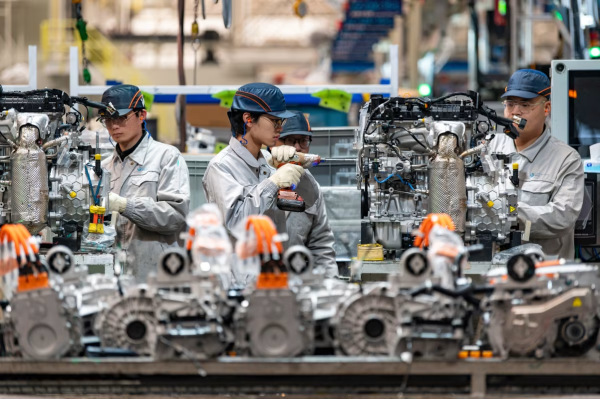
And the staggering surplus figure is also testament to the country’s rapid climb to dominate green technologies like EVs, lithium-ion batteries, and solar panels, as well as its prowess in making machinery and tech products at scale.
The influx of those goods into markets across the world – especially as fierce competition and weak demand in China has meant companies need to export to survive – has been welcomed in some markets, and led to deep frictions with others, who say subsidized Chinese goods are crushing domestic competition.