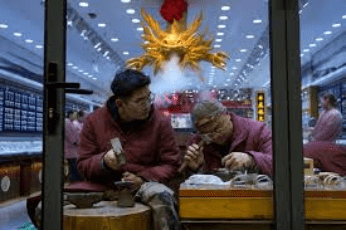
China’s GDP increased by 5% in 2025 ending Dec 31, which was in line with the official target of the Chinese government but still faced challenges due to the soft domestic demand and the global trade tensions that were going on. Exports were again a major factor in keeping the overall economic performance of China; however, the U.S. Tariff imposed by President Trump inflicted a remarkable reduction in imports coming into the country. On the other hand, the economic growth of China has got significantly slowed down in Q4 of 2025 as it only recorded 4.5% of GDP growth during the period from October 1, 2025 – December 31, 2025, this was the slowest quarterly GDP growth since Q4-2022 when the economy was beginning to recover from harsh COVID-19 policies. The principal reason for the downturn in the Chinese economy will be the long-lasting limitation of the real estate market, coupled with low consumer confidence and low business investment levels. In any case, the exports were the only positive aspect of the economy throughout the year 2025 because China set an all-time high trade surplus of $1.2 trillion largely due to the inflow of Chinese exports which was sufficient to cover the outflow of domestic consumption. Even though the volume of Chinese goods shipped to the U.S. dropped massively compared to the previous year (over twenty percent decrease), the exports to other countries compensated more than enough for this loss. The temporary deal clinched between President Trump and Chinese President Xi is also gradually relieving the Chinese exporters from the tariffs that were previously increased.
Analysts caution that exports should not be the sole focus of people’s interest. Some countries like Mexico have raised tariffs on Chinese products and the EU has also hinted at similar actions. If governments in other countries protect their local production, China’s growth from exporting will shrink, economists predicted. The mounting problems concerning the economy even make the situation at home very difficult still. Consumer confidence is down to its lowest level, and many households are reluctant to spend because they are not sure about their income and job security. The real estate market, which was one of the critical factors to economic growth, has continued to be a problem for the economy as well. According to the experts, the first thing that has to be done is to stabilize the housing market, which would ultimately build up the consumer’s confidence, leading to spending and investment in the private sector. In order to boost the sluggish economy, China has come up with a variety of government spending programs, one of them being the trade-in incentives for cars and home appliances. These measures had a positive impact at the beginning of the year but have already faded away, and analysts believe that most of these will wind up being phased out by 2026.
Besides the official optimism expressed concerning the economic recovery in China, independent economists have voiced their skepticism about how vigorous the recovery is. The Rhodium Group’s estimate suggests that actual growth for 2025 might have been only about 2.5% to 3%, far below the government’s figures. The Chinese economy is expected to slow down further – Deutsche Bank’s forecast is that the GDP growth will be about 4.5% in 2026. Though the growth rates may be reduced and accepted, the Chinese government considers the stability of the economy as the key factor to social stability, which is the goal of the government in the long run, sustainable development. Neil Thomas, a Fellow at the Asia Society Policy Institute’s Center for China Analysis, notes that “while China could keep most of its social stability at lower GDP growth rates, Beijing still wants the economy to always be growing.” For China to achieve its 2035 target of $20,000 per capita GDP (gross domestic product), it needs to grow its GDP at a rate of about 4% to 5% per year during that period.